


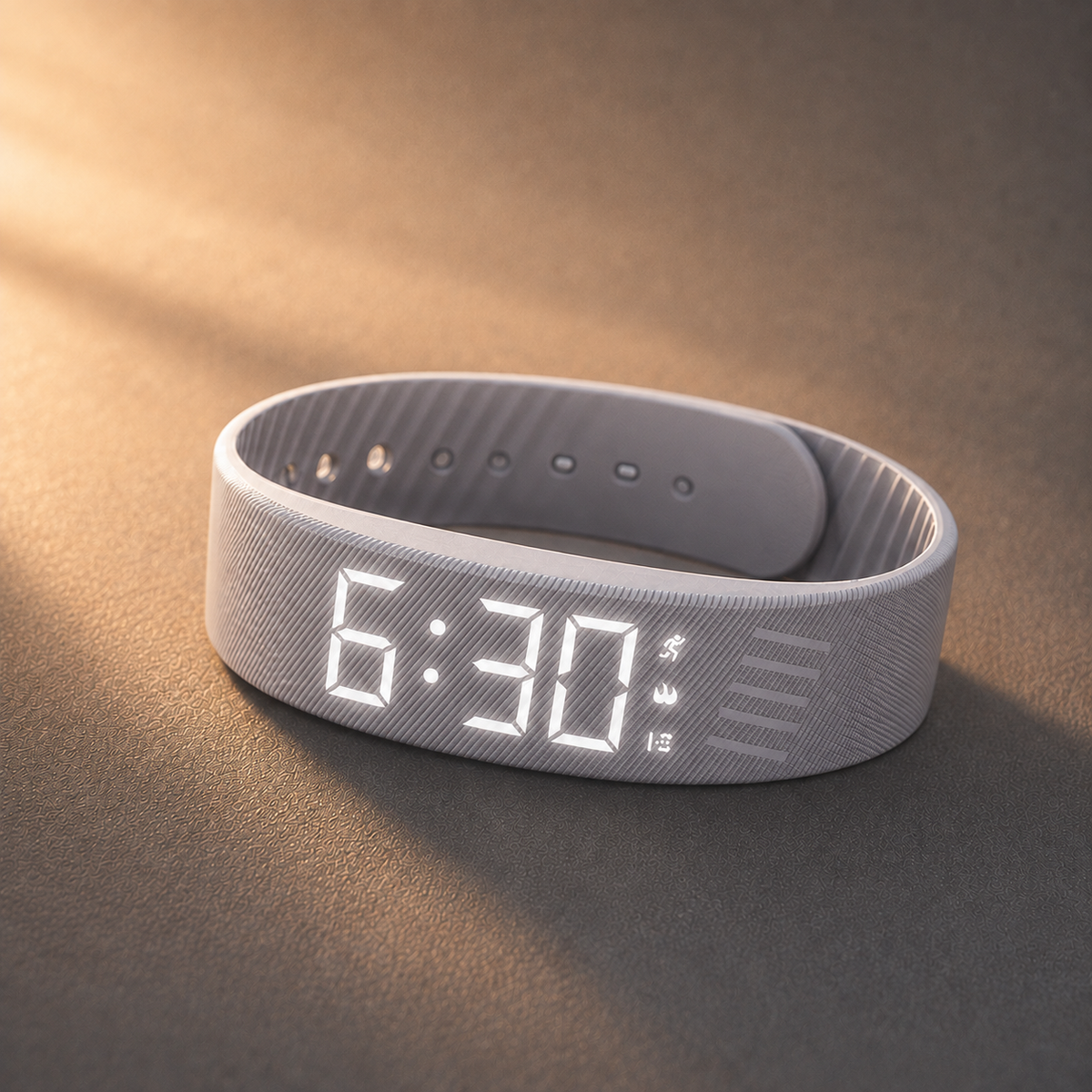

The alarm for people who sleep through alarms — and the people who have to hear them.
No sound. No phone. No app. It taps you awake on the wrist, and keeps tapping until you press the button.

You're not lazy. Sound just isn't reaching you.
Some people need a much louder sound than others to wake from deep sleep. If you're one of them, a sixth alarm was never going to fix it. You don't need more noise. You need a different kind of signal.
- Reaches you through skin contact, not through the air
- Already on your wrist — nothing to find in the dark
- Nobody else in the room hears a thing
- No phone, no app, no software update to break it

- Fills the whole room — everyone in it wakes up
- One blind swipe kills it — and you won't remember doing it
- Competes with the fan, the traffic, and their breathing
- Needs charging every night, and updates break it
Three buttons. No setup wizard. No account.
Set it before bed
Set the time straight on the band. There's no phone to pair, no app to download, and no account to make. It works exactly the same on a plane, in a basement, or with your phone dead.
It taps, it doesn't ring
At your alarm time the motor pulses against your wrist. Because the signal travels through direct skin contact instead of across the room, it doesn't have to be loud to reach you — and there's nothing for anyone else to hear.
You press the button to stop it
Not a swipe across a screen your hand already knows how to find. A deliberate press on a physical button, on your wrist, while the thing is still buzzing against your skin.
People used to get woken by a tap on the window.
Before alarm clocks were cheap, British factory workers paid someone a few pence a week to walk the streets before dawn and tap on their bedroom window with a long pole. They were called knocker-uppers.
They used a tap instead of a bell for a simple reason: a bell woke the whole street. A tap woke one person.
We put the tap back. On your wrist.
Built for mornings that actually cost something.
Early shifts and hard start times
- Nursing, trades, aviation, logistics, warehouse
- For the 4:30s where being late is a write-up
- Works with no signal, no phone, no charger
Couples on different schedules
- One of you is up at 4:30 — not both of you
- No sound means nothing for them to sleep through
- Stop being someone's backup alarm
People who turn alarms off in their sleep
- A button you press, not a screen you swipe
- On your wrist, so it's still buzzing while you do it
- Nothing to walk across the room for
Shared rooms and travel
- Dorms, hostels, barracks, house shares
- Hotel rooms with someone still asleep in them
- Two weeks of battery means one less charger to pack
How it stacks up against what you've already tried.
| VibeBand™ | Phone alarm | Smartwatch | Bed shaker | |
|---|---|---|---|---|
| Wakes you without waking the room | ||||
| Can't be killed by one blind swipe | ||||
| Works with no phone, app, or account | ||||
| Packs in a pocket for travel | ||||
| Loud enough to hear across the room |
The things you're actually wondering.
What if I sleep through the vibration too?
It's possible — people vary, and nobody can honestly guarantee otherwise. But it's a different bet: the signal reaches you through your skin, so it isn't competing with a fan, traffic, or someone breathing next to you. You have 30 days to find out on your own wrist.
Will my partner really not hear it?
There's no speaker in it — no beep, no tone. Just a small motor, which makes a faint hum up close, like a phone buzzing on a table. On a wrist under a duvet, that's usually the end of it.
Is it complicated to set up?
No pairing, no app, no account. You set the time and the alarm using the buttons on the band. A printed card in the box gives you the exact sequence, and we'll walk you through it if you get stuck.
Battery and charging?
About 14 days per charge, over USB. Charge it on a fixed day twice a month and a flat battery is never a surprise the night before an early start.
Can I shower or swim with it?
Splash-resistant — fine for sweat, rain and hand-washing. Not rated for swimming or being held under water, so take it off before the pool or a long bath.
Will it fit me, and is it comfortable to sleep in?
The silicone strap fits wrists from about 12 to 19cm, which covers most adults and teenagers. It's light and soft and meant to be worn overnight — though some people just don't like wearing anything in bed, and that's what the return window is for.
Does it track my sleep?
There's a basic sleep monitor and step counter included. Useful for spotting trends, but VibeBand is built to wake you up rather than analyse you — if you want detailed data, a dedicated tracker will serve you better.